



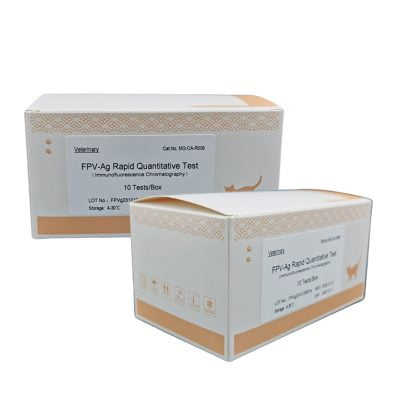
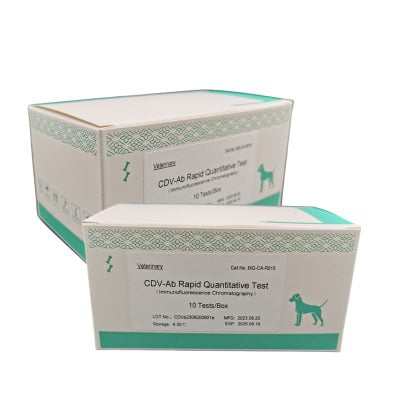
Migi (Cat) Feline FPV/FHV/FCV Ab Rapid Quantitative Test Kit
$ 97.20
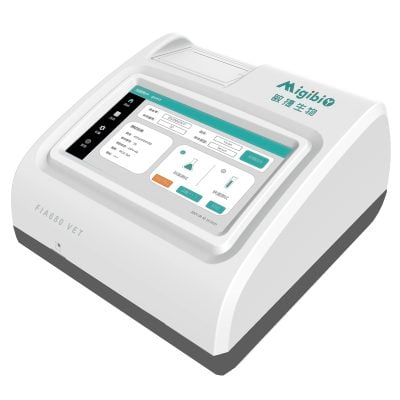
Notice: You need an Immunofluorescence Analyzer to run the tests with this kit Contact us for the equipment and test kits combo wholesale SPECIFICATION 10 Test/Box Cat.No.:MG-CA-R033 INTENDED USE The Feline FPV/FHV/FCV Ab test is a quantitative fluorescence immunoassay used with an Immunofluorescence Analyzer. It determines the concentration of antibodies to feline panleukopenia virus (FPV), feline herpesvirus (FHV), and feline calicivirus (FCV) in serum or plasma samples. For in vitro diagnostic use only. For professional use only. TEST PRINCIPLE This test employs a quantitative double antigen sandwich fluorescence immunoassay technique. The fluorescent signal intensity reflects the amount of FPV-Ab, FHV-Ab, FCV-Ab captured. The concentration is expressed as Tu/ml. MATERIAL Material Provided Material Required But Not Provided 10 individual sealed pouches, each containing: â– Test Device of FPV-Ab, FHV-Ab, and FCV-Ab (antibody test for Feline Panleukopenia Virus, Feline Herpesvirus, and Feline Calicivirus) ■Desiccant pouch 1. Immunofluorescence Analyzer (for reading test results) One ID Chip 2. Timer Instructions for Use 3. Pipette (already provided) 10 tubes of FPV/FHV/FCV Ab Sample Buffer 4. Centrifuge (not typically required for antibody tests) 10 Pipette tips  STORAGE AND STABILITY Store the test kit at 4~30℃ up to the expiration date. The test should operate at 18 ~ 28℃ after the Test Device opening. Once the pouch is opened, the test should be performed within 30 minutes. SPECIMEN COLLECTION AND PREPARATION The test can be performed with serum or plasma. Separate serum or plasma (EDTA anticoagulant is recommended) from blood within 3 hours after blood collection. If a specimen appears to be severely hemolyzed, another specimen should be obtained and tested. Optimally, the test should be performed immediately after the specimen collection. If the test cannot be performed within 3 hours after blood collection, store the specimen at 2~8℃ for no longer than 72 hours. For long-term storage, specimens shall be kept below -20℃. Bring all materials to room temperature before use. Frozen specimens must be completely thawed and mixed well prior to testing. Specimens should not be frozen and thawed repeatedly. Only clear, non-hemolyzed specimens can be used. TEST PROCEDURE Preparation: Set a Test Device on a clean, level horizontal table. Insert the ID Chip into the meter and click “Read ID chip.” Make sure the Test Device lot number matches the ID Chip number. Sample Preparation: Pipette 20 μl of prepared sample into FPV/FHV/FCV Ab Sample Buffer. Gently mix well. Avoid vigorous agitation and foaming. Run the Test: Choose between Standard Test (a) or Quick Test (b). (a) Standard Test: * Pipette 100 μl of mixed sample into the sample well (S) of the FPV-Ab Test Device. * Click “Standard Test,” insert the FPV-Ab Test Device into the meter holder, and click “Start Test.” Select sample type “Serum/Plasma.” The meter will countdown and read the result automatically. * Repeat for FHV-Ab and FCV-Ab Test Devices, clicking “Start Test” for each after inserting them into the holder. (b) Quick Test: * Pipette 100 μl of mixed sample into the sample well (S) of the FPV-Ab Test Device. * Click “Quick Test,” start the timer immediately. * Leave the FPV-Ab Test Device at room temperature (18°C – 28°C) for 10 minutes. * Insert the FPV-Ab Test Device into the meter holder and click “Start Test.” Select sample type “Serum/Plasma.” The instrument will scan the Test Device automatically and show the test result. * Repeat for FHV-Ab and FCV-Ab Test Devices, inserting them in turn and clicking “Start Test” for each. Results: Results are displayed on the main screen. Printing is automatic or can be done by clicking “Print.” QUALITY CONTROL The FPV/FHV/FCV Ab Rapid Quantitative Test includes a built-in quality control check for every test run with a patient sample. This internal control ensures the test’s accuracy. If the internal control fails, the meter will display an error message, and you’ll need to repeat the test with a new Test Device and sample. INTERPRETATION Reference range of FPV/FHV/FCV in feline serum or plasma. Detection range : â‘ FPV-Ab:4.5 ~640 Tu/ml â‘¡ FHV-Ab:5.0 ~640 Tu/ml â‘¢ FCV-Ab:5.0 ~640 Tu/ml Reference range:   Result(Tu/ml) Level Suggestion FPV-Ab FHV-Ab FCV-Ab ≤9 ≤10 ≤10 0 No antibody protection vaccination is recommended 9~50 10~15 10~30 1 The antibody protection is weak, so it is recommended to carry out supplementary immunization or adjust the immunization program 50~ 150 15~45 30~90 2 150~ 300 45~ 100 90~ 200 3 Moderate antibody protection, strengthen antibody level monitoring once every 6 months or so 300~ 500 100~ 150 200~ 300 4 >500 >150 >300 5 The antibody protection is strong, and the antibody level is tested every year to ensure the vaccine protection in time  Note ast Infection: If your pet has not been vaccinated but the test results show antibody levels above level 1 (refer to the results table for specific levels), it suggests the pet may have been infected with the virus in the past. This past exposure could have triggered an immune response and produced antibodies. Individual Variation in Antibody Levels: The antibody levels for FPV, FHV, and FCV in the test results may not be identical, even though the test is run simultaneously. This is because each pet’s immune system reacts differently to vaccines. Don’t be alarmed by slight variations between the three viruses. Refer to the results table for interpretation based on the specific levels for each virus. Each laboratory should establish a reference range that represents the population to be evaluated. WARNINGS AND LIMITATIONS OF THE PROCEDURE This kit is for in vitro diagnostic use only. Inspect the packaging and labels before use. Do not use it if the pouch is broken, torn, or not well sealed, or if the vial looks damaged or leaked. Do not use the test device beyond the expiration date. One pipette tip should be used for one specimen only. There is the possibility that factors such as technical or procedural errors and additional substances in blood specimens that are not listed in the text may interfere with the test and cause erroneous results.
Related products
-

-
-
Migi (Cat) Feline Herpes Virus Antibody (FHV-Ab) Rapid Quantitative Test Kit
$ 45.00Superior Hybrid | Superior Indica | Superior Sativa This product has multiple variants. The options may be chosen on the product page